
· by Michael Blair, Nashville's Water Filtration
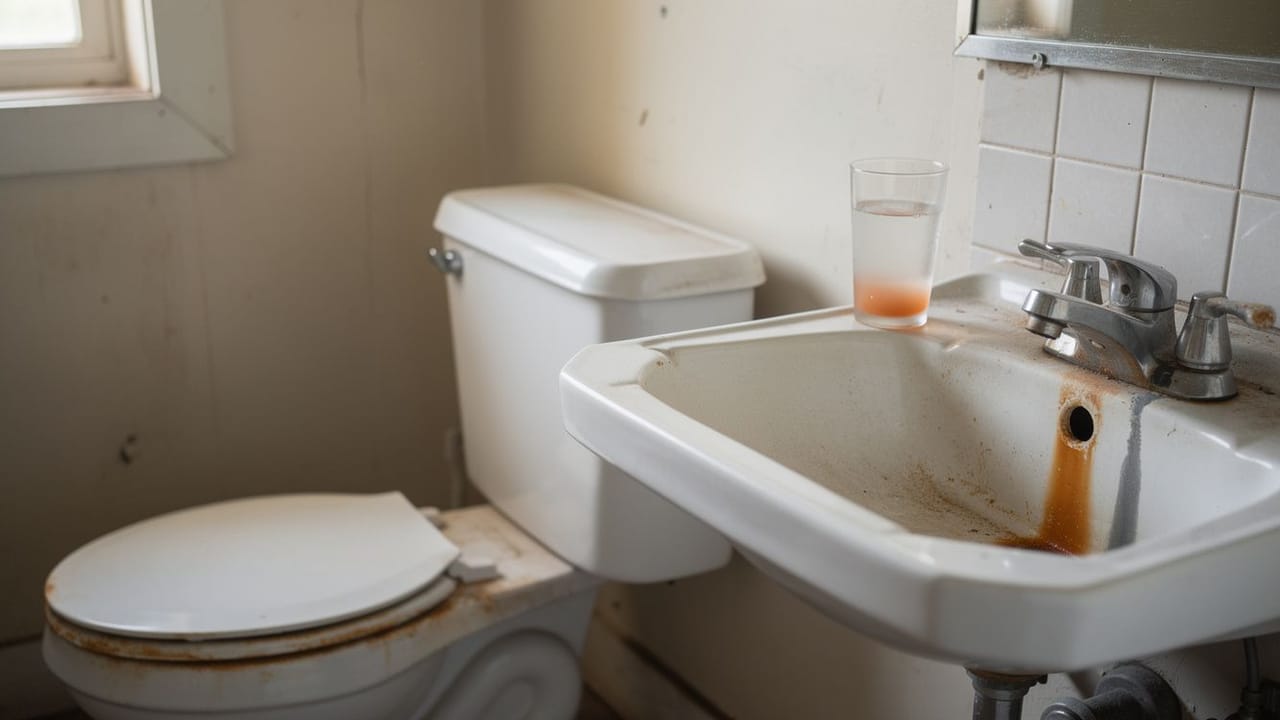
A rust-colored ring in the toilet, an orange streak under the faucet, or black specks in the sink are the most common complaint we hear from homes on a private well. The stain is the symptom. The cause is almost always iron or manganese dissolved in the water, and the color tells you which. Here is how to read it, why cleaning the fixture never ends the problem, and how a test result decides the treatment.
What do orange, brown and black stains in a sink mean?
Orange, red-brown or rust-colored stains mean iron, and brown-black or black stains mean manganese. The EPA’s secondary drinking water standards set iron at 0.3 mg/L and list reddish or orange staining, sediment and a metallic taste among its effects, and set manganese at 0.05 mg/L, with black staining and a bitter metallic taste. Those are guidelines for taste, color and staining, and the EPA does not enforce them.
Iron itself is a nuisance rather than a health problem; Penn State Extension’s guide to iron and manganese says neither metal is a health concern at the staining levels. Manganese has a second number, though. Penn State notes an EPA health advisory of 0.3 mg/L, and the Connecticut Department of Public Health uses 0.3 mg/L as its action level for private wells, stressing it for pregnant women and young children.
Why does well water come out clear and then stain?
Clear water that stains later is carrying dissolved iron. Penn State explains that in this reduced form the water looks clear at first, then forms orange-brown or black particles as it meets oxygen, and that the dissolved form is most common in groundwater with a pH below 7.0. Connecticut describes the same thing: clear from the tap, then a red or black tint as it sits in air. Water that is already rusty or black when it comes out carries the metals in their oxidized form.
Connecticut lists two other causes worth ruling out. Corroding iron pipes and equipment can shed reddish-brown particles that settle out, usually in water with a low pH. Iron and manganese bacteria leave a red-brown or black-brown slime, often in the toilet tank, and the standard coliform test does not detect them. On Nashville city water, Metro’s 2025 water quality report shows iron not detected and manganese far below its standard, so the supply is an unlikely source; our post on what is in Nashville water covers the rest of that report.
Why do iron stains come back after scrubbing?
Iron stains come back because the iron arrives with every gallon, so a clean bowl is only clean until the next flush. Cleaning products also work against you. Connecticut’s health department says soaps and detergents will not remove these stains and that chlorine bleach or alkaline builders may make them worse, which is the opposite of what most people reach for first.
The fixtures are only the part you can see. Connecticut adds that iron and manganese deposits build up in plumbing lines, pressure tanks, water heaters, softeners and other treatment equipment, cutting their effectiveness and the water pressure in the house. So the lasting fix sits where the water enters the home, and Penn State says that for these two metals the treatment belongs at the point of entry, since they affect every use of the water.
Which treatment fits which iron level?
The lab number decides it, so water testing comes first: iron, manganese, pH and hardness, from a certified laboratory, as both the EPA and Connecticut advise. Penn State’s ranges then sort the options. A water softener is generally recommended only when pH is above 6.7, hardness is 3 to 20 grains per gallon and dissolved iron is under 5 mg/L, with no air or chlorine reaching the water before it. Polyphosphate suits dissolved iron under 2 mg/L but only hides it, and does little for manganese. Manganese greensand fits combined iron and manganese of 3 to 10 mg/L; above 10, oxidation followed by filtration, usually with chlorine.
Connecticut’s table draws the lines differently, putting greensand under 15 mg/L combined, ion exchange under 5, aeration under 25, chemical oxidation and filtration above 10, and phosphate under 3 mg/L of iron. We size a system from your own numbers, with treating well water in Middle Tennessee as the wider picture. Ask us for an estimate and we will start with the test.
Sources
- U.S. EPA, Secondary Drinking Water Standards: Guidance for Nuisance Chemicals — Iron 0.3 mg/L (rusty color, sediment, metallic taste, reddish or orange staining); manganese 0.05 mg/L (black to brown color, black staining, bitter metallic taste); not federally enforced; private well owners should use a certified laboratory
- Penn State Extension, Iron and Manganese in Private Water Systems — Not health concerns at secondary levels; EPA manganese health advisory 0.3 mg/L; dissolved iron clear at first, most common below pH 7.0; point-of-entry treatment; softener above pH 6.7, 3 to 20 gpg, dissolved iron under 5 mg/L; polyphosphate under 2 mg/L; greensand 3 to 10 mg/L combined; oxidation and filtration above 10 mg/L
- Connecticut Department of Public Health, Iron and manganese in private well water (July 14, 2026) — Iron red-brown, manganese brown-black staining; soaps will not remove them and bleach may make them worse; deposits in pipes, tanks, heaters and softeners; iron bacteria slime; corroding pipes; manganese action level 0.3 mg/L; Table 1 treatment ranges (greensand under 15, ion exchange under 5, aeration under 25, oxidation over 10 mg/L combined; phosphate under 3 mg/L iron)
- Metro Water Services, 2025 Water Quality Report — Iron not detected (under 0.025 mg/L) and manganese 0.0012 mg/L against secondary standards of 0.3 and 0.05
FAQ
Orange, Brown and Black Stains From Well Water — questions
What causes brown stains in a toilet bowl?
On a well, usually iron or manganese in the water. The EPA links iron to reddish or orange staining and manganese to black staining. Connecticut’s health department adds that iron bacteria can leave a red-brown or black-brown slime in the toilet tank. A lab test for iron, manganese and pH tells you which it is.
Will bleach remove iron stains?
Do not count on it. Connecticut’s Department of Public Health says soaps and detergents will not remove iron and manganese stains, and that chlorine bleach or alkaline builders may make them worse. The stains also return as long as the iron stays in the water, so the lasting answer is treatment where the water enters the house.
Does a water softener remove iron?
Sometimes. Penn State Extension says a softener is generally recommended for iron only when pH is above 6.7, hardness is 3 to 20 grains per gallon and dissolved iron is under 5 mg/L. Iron that has already oxidized fouls the resin, so the water must not meet air or chlorine before it reaches the softener.
Is iron in well water harmful?
Not at staining levels. Penn State Extension says iron and manganese are not health concerns at their secondary standards. Manganese has a higher, health-based figure: Penn State notes an EPA health advisory of 0.3 mg/L, and Connecticut uses 0.3 mg/L as its action level for private wells, stressing it for pregnant women and young children.
How much iron in well water is too much?
The EPA’s secondary standard for iron is 0.3 mg/L, the level above which reddish or orange staining, sediment and a metallic taste become noticeable. For manganese it is 0.05 mg/L. The EPA does not enforce them, and Penn State notes that private wells fall outside state and federal standards anyway.