
· by Michael Blair, Nashville's Water Filtration
Outside Metro’s service area, private wells are common across Middle Tennessee. They are not regulated or monitored, so testing and treatment are entirely the owner’s responsibility.
What should well water be tested for?
Bacteria annually at minimum. Then nitrates, hardness, iron, manganese, pH and total dissolved solids. On limestone geology, hardness is close to guaranteed.
A test after any flooding, after work on the well, and whenever taste, smell or appearance changes.
The common results and what they need
Bacteria: shock chlorination and then continuous disinfection, commonly ultraviolet. Iron and manganese: oxidizing filtration, which addresses the orange and black staining.
Hydrogen sulfide, the rotten egg smell, needs oxidation and filtration. Hardness needs softening. Low pH needs a neutralizing filter, and it is worth addressing because acidic water corrodes plumbing.
- Test for bacteria annually, more after flooding
- Iron and manganese cause orange and black staining
- Rotten egg smell is hydrogen sulfide
- Low pH corrodes plumbing and needs neutralizing
- Sediment pre-filtration protects everything downstream
What order should well water treatment go in?
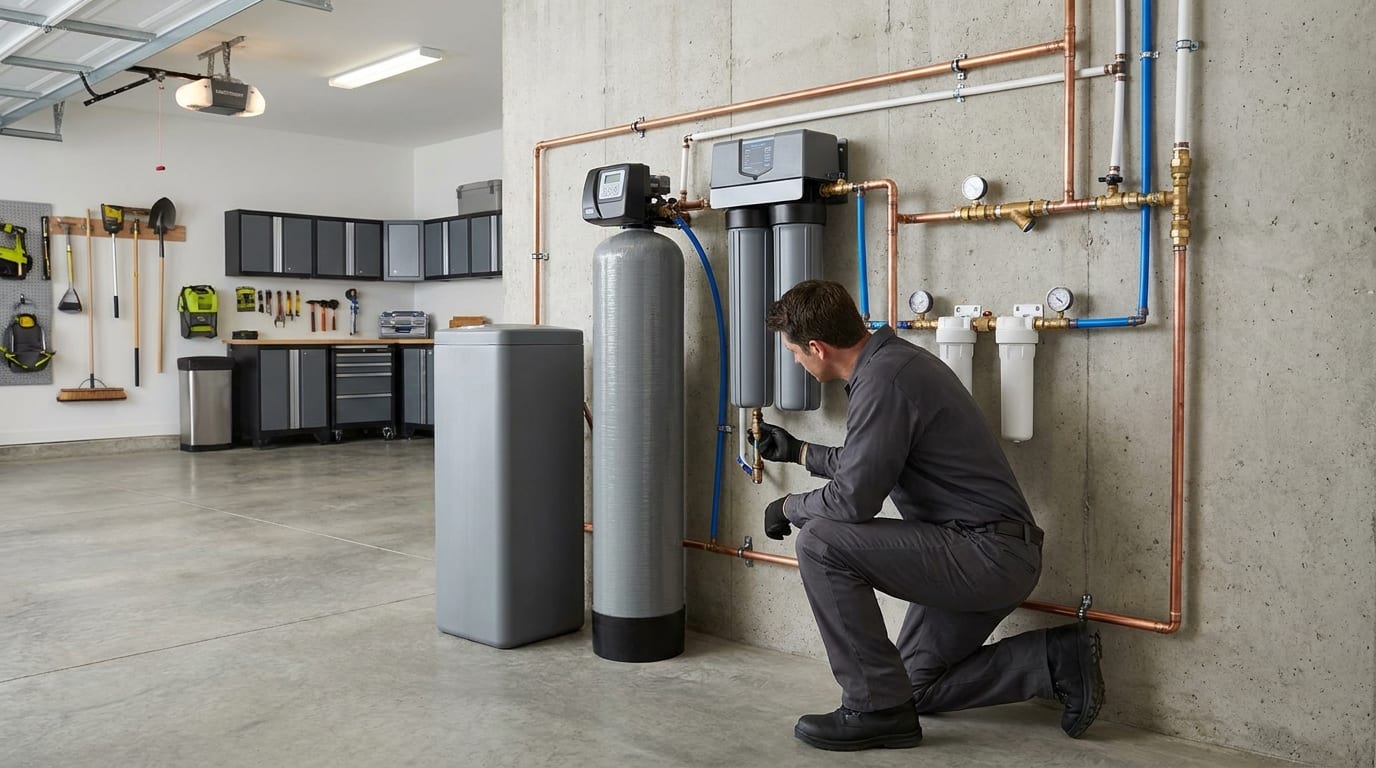
Treatment components go in a specific sequence — sediment, then oxidation and filtration, then softening, then disinfection. Out of order, each stage fouls the next.
This is where a designed system differs from a collection of purchased units.
Maintaining the well itself
The cap should be sealed and above grade, the surrounding ground should slope away, and there should be no septic or livestock too close.
Most bacterial contamination in Middle Tennessee wells is surface water entering at the head rather than anything in the aquifer.
FAQ
Treating Well Water in Middle Tennessee — questions
How often should I test well water?
Bacteria annually at minimum, plus nitrates and a broader panel every few years. Test additionally after flooding, after any work on the well, and whenever taste, smell or appearance changes. Nobody else is monitoring a private well, so the schedule is entirely yours to keep.
Why does my well water smell like rotten eggs?
Hydrogen sulfide, either from the aquifer or produced by bacteria in the well or water heater. If it is only on the hot side it is usually the heater’s anode rod reacting, which can be changed. On both hot and cold it is in the water and needs oxidation and filtration.
What causes orange staining from well water?
Iron, and black staining alongside it indicates manganese. Both are common on Middle Tennessee well water and both are treated by oxidizing filtration, which converts the dissolved metal to a particle the filter can remove. A softener alone handles only small amounts.
How do you maintain a private water well?
Keep the well cap sealed and above grade, make sure the ground slopes away from it, and keep septic systems and livestock at a distance. Most bacterial contamination in Middle Tennessee wells is surface water getting in at the head, not a problem in the aquifer. Then test for bacteria at least once every year.