
· by Michael Blair, Nashville's Water Filtration
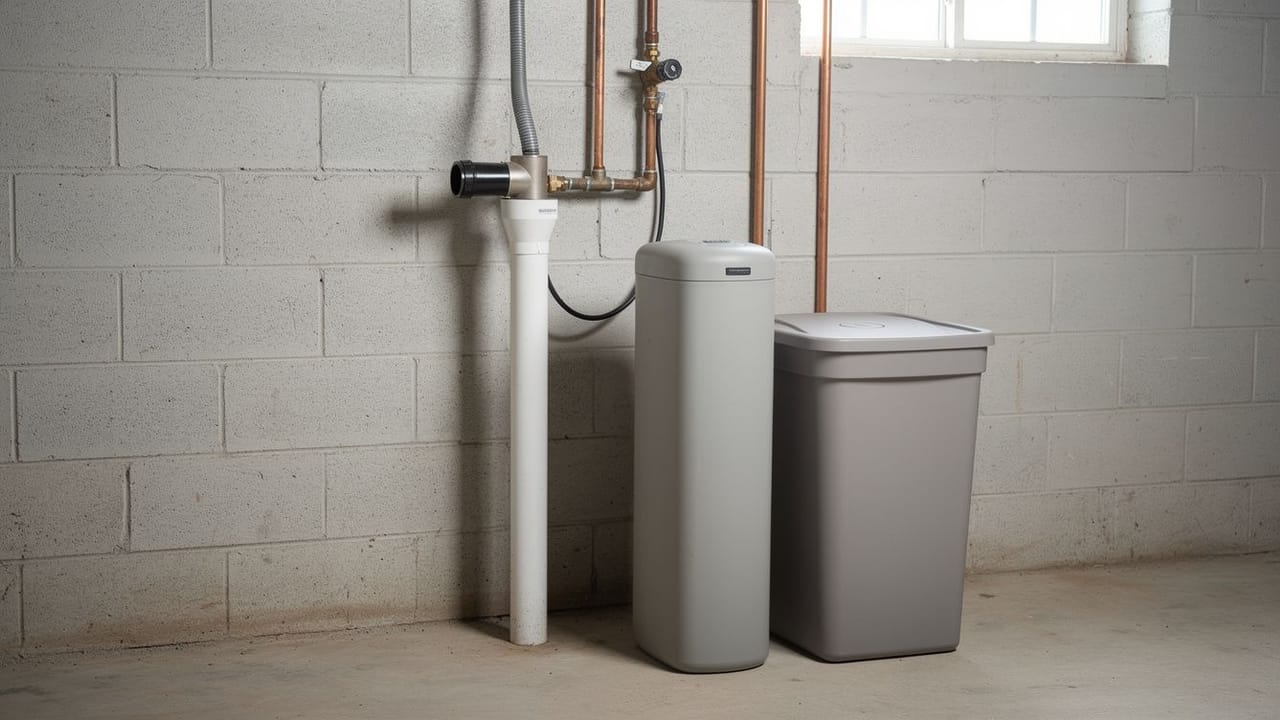
Most people picture a softener installation as setting two tanks on the floor and connecting them to the water line. That part takes the least thought. A softener regenerates on a schedule, and every time it does it sends water down a drain: the backwash that loosens the resin bed, the brine that strips the hardness off the beads, and the rinse that clears the brine out. Where that water goes, how the drain line gets there, and what keeps it from ever flowing backward into the house supply are the questions that decide whether an install is right. They are the first things we look at when we plan a water softener for a home, whether it is a first unit or a replacement.
Why the drain line never connects straight to a pipe
A softener drain line is a flexible tube or small pipe that carries regeneration water from the control valve to a drain. The tempting way to finish it is to push it into a drain pipe and seal it there. That is the one thing it must not do. A drain that is sealed to the waste system can, if that system backs up, push waste water back toward the softener, and the softener sits on the line that feeds every faucet in the house.
The fix is a gap of open air between the end of the drain line and the drain it empties into. The Pentair Fleck 5600SXT service manual, for one of the most common softener control valves, says plainly that the drain line must have an air gap to prevent back flow, and sets that gap at twice the diameter of the drain pipe and never less than one inch. Water can fall across that space into the drain. Nothing can climb back up it.
The plumbing code says the same thing in general terms. Chapter 8 of the 2021 International Plumbing Code, which you can read in its Tennessee edition at UpCodes, covers indirect waste. Section 802.1.5 sends clear-water waste from devices such as filters, process tanks and boilers through an indirect waste pipe with an air break or an air gap. Section 802.3 has that pipe discharge into a waste receptor, a standpipe, floor drain or laundry sink, and 802.3.1 sets an air gap at no less than twice the opening of the pipe. The chapter does not name softeners. It describes the kind of connection a softener drain is, and the manufacturer’s manual fills in the specifics.
Tennessee and Metro Nashville are not on the same edition of the plumbing code. The State Fire Marshal’s list of currently adopted codes shows the 2021 International Plumbing Code, effective April 17, 2025. Metro Codes’ adopted codes list shows the 2024 International Plumbing Code. Which one applies depends on where the house is and who inspects it, and the section numbers quoted above are from the 2021 text. Metro Nashville Codes also notes that building and trades permits are applied for by registered contractors.
Drain size, length, and where the receptor can be
A drain line that is too small or too long slows the backwash. The resin bed does not lift and loosen the way it should, regeneration does a worse job, and the softener drifts toward the symptoms people call us about later, the ones our post on replacing a water softener or repairing it walks through. The Fleck manual sets the residential drain line at half an inch at minimum, and calls for three-quarter inch when the backwash flow runs over 7 gallons per minute or the line runs longer than 20 feet.
That 20-foot figure matters more than people expect. The softener usually goes where the water line enters the house, which is not always next to a floor drain or laundry sink. In a basement the receptor is often close. In a garage install on a slab, the nearest standpipe can be across the room or through a wall, and the line size has to change to match the run.
The code also limits where the receptor can be. Section 802.4 keeps waste receptors out of concealed spaces and crawl spaces and requires ready access to them. So a softener in a crawl space does not get to dump its regeneration water into a pipe stub hidden under the floor. The receptor has to be somewhere a person can see it and reach it, which also means somewhere a person will notice when it overflows.
- An air gap of at least twice the drain line’s diameter, and never under one inch
- Half-inch drain line at minimum; three-quarter inch over 20 feet or above 7 gallons per minute of backwash
- A standpipe, floor drain or laundry sink in the open, never one in a crawl space or inside a wall
- A bypass valve, so the house keeps water while the softener is serviced
The rest of the install: bypass, power, pressure, freezing
The bypass is the other piece every install needs. The Fleck manual says to provide one if the softener does not come with it. It lets the house run on unsoftened water while the softener is being worked on, and it is how we test hardness before and after the unit without cutting a line.
The same manual sets the conditions the softener has to live in. Water pressure between 20 and 125 psi. Water no hotter than 110 degrees, which rules out a spot downstream of the water heater. A dry location that will not freeze, which in Middle Tennessee rules out an uninsulated garage wall or an unheated outbuilding unless it is protected. And an outlet that is always on, not one controlled by a wall switch, because a softener that loses power loses its timing and may skip regenerations without anyone noticing.
The manual also says that heavily limed pipe, or pipe clogged with iron, should be replaced, and that a separate iron filter belongs ahead of the softener when iron is the problem. That is the reason we look at the pipe where it comes out of the wall and test the water before we size anything.
Sewer or septic is the first drain question
On city sewer, the regeneration water goes down the drain with the rest of the house’s waste, and the air gap and line size are the whole story. Plenty of homes in the rural parts of Williamson, Wilson, Cheatham and Dickson counties are on a well and a septic tank instead, and there the question is where the brine ends up. For a home outside Franklin on a well, the softener is usually one piece of a larger well water treatment setup, and the drain is the part of it that touches the septic system.
The research on septic tanks points to how much salt goes in, more than to the softener itself. A 2012 Virginia Tech thesis, Changes in Septic Tank Effluent Due to Water Softener Use, found that sodium added to a tank was likely to affect what came out of it. Heavy slugs of salt from inefficient regeneration raised the solids and the oxygen demand in the effluent, and the effects were much smaller when less excess sodium went in. How much it mattered depended on the water’s hardness, on whether the regeneration water entered the tank at all, and on that excess sodium.
That gives an installer two things to work with. A softener sized for the water and set to regenerate on demand, rather than on a fixed calendar, sends less salt to the drain. And where the regeneration water goes is a choice made at installation, which is why we settle it before the unit is set, not after.
The question to put to any installer is which edition and which inspector cover your address, and how the drain will meet it. If you want us to look at where a softener would go in your house and how it would drain, ask for a free estimate.
Sources
- Pentair, Fleck 5600SXT Downflow Service Manual — Air gap required on the drain line, twice the drain diameter and at least one inch; drain line sizing; bypass; pressure, temperature, location and power requirements; iron filter ahead of the softener.
- International Plumbing Code 2021, Chapter 8 (Tennessee), UpCodes — Sections 802.1.5, 802.3, 802.3.1 and 802.4 on indirect waste, air gaps and waste receptor locations.
- Virginia Tech, Changes in Septic Tank Effluent Due to Water Softener Use (P. L. Hogan, 2012) — Effects of softener regeneration waste and excess sodium on septic tank effluent.
- Tennessee State Fire Marshal’s Office, Currently Adopted Codes — The state enforces the 2021 International Plumbing Code, effective April 17, 2025.
- Metro Nashville Codes, Adopted Codes List — Metro lists the 2024 International Plumbing Code.
- Metro Nashville Codes — Registered contractors apply for building and trades permits.