
· by Michael Blair, Nashville's Water Filtration
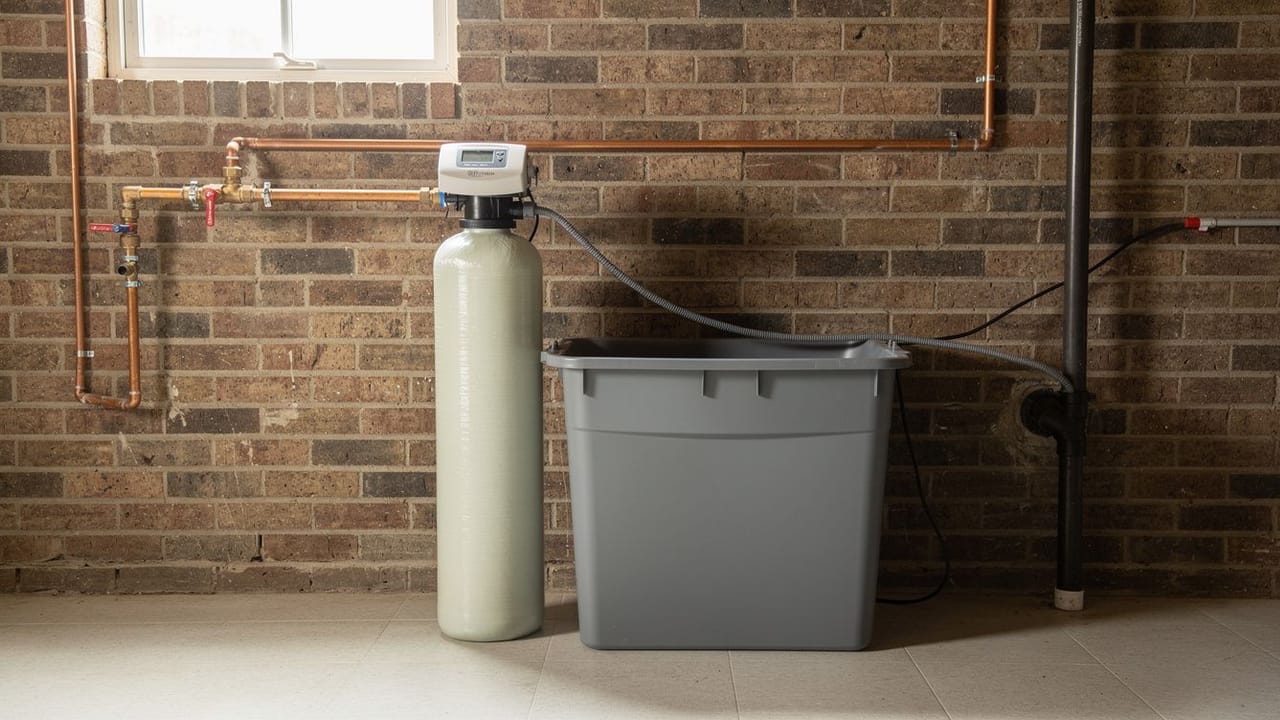
A softener that has stopped softening is not automatically a softener to throw away. The cabinet or tank on the floor is three parts that wear out on their own schedules: a bed of resin beads that does the softening, a control valve that runs the regeneration, and a brine tank that makes the salt solution the resin is washed with. Some failures are a cleaning, some are a valve part, and some are a resin bed that will not come back. When we look at a water softener that is acting up, the job is to find out which one it is before anyone talks about a replacement.
What we check before calling it a replacement
The usual complaint is that the hard water is back: spots on the glasses again, scale returning on the shower glass, soap that will not lather the way it did. The first thing we rule out is the brine tank, because it is the cheapest problem and it imitates a dead softener exactly. The Water Quality Association’s glossary of water treatment terms describes bridging as salt fusing into a solid mass so the brine below is not saturated and there is too little salt to properly regenerate the resin, and mushing as pellets breaking down into a crystallized sludge; it says both require the brine system to be cleaned. If that is what we find, the softener itself may be fine, and our post on salt types and brine tank bridges covers clearing and preventing it.
With the brine tank ruled out, we test hardness at a softened tap and again at the bypass, so we know what is coming in and what is getting through. Then we start a manual regeneration and follow it cycle by cycle. A healthy valve moves through backwash, brine draw, rinse and refill, with water running to the drain at each step and the brine tank level dropping during the draw. A motor that hums without the valve moving, a drain that runs on long after the cycle should have ended, or a brine tank that never drops tells us the valve is the problem. Salt use is the other clue: salt disappearing much faster than it used to, or not going down at all, means the regeneration is not doing what the settings say.
- Hardness at the softened tap compared with the bypass
- Each regeneration cycle watched, with flow to the drain at every step
- Brine tank level before and after the brine draw
- Softened water tested right after regeneration and again a few days later
When the resin bed is the part that has failed
That last test is the one that points at the resin. Water that is soft right after regeneration and turns hard again well before the next one means the bed is holding less than it should. The two causes the research supports are oxidation and fouling. The WQA glossary defines oxidation as an oxidant such as chlorine, peroxide or ozone attacking the structure of the resin beads and shortening the resin’s life. The University of Minnesota Water Resources Center’s guide to residential softening says chlorine degrades resin beads, that a chlorine concentration of 2 parts per million can cut their life in half, and suggests a chlorine filter ahead of the softener above 1 ppm.
Iron is the other one. The glossary calls it iron fouling when iron builds up on or within the resin until its capacity drops, and Penn State Extension’s page on water softening notes that iron exposed to air or chlorine will clog the resin and that some resins cannot be washed clean and have to be replaced. The Minnesota guide pairs a softener with a separate iron filter above 3 ppm of iron and uses a resin bed cleaner on a schedule set by the iron level. On Metro Nashville water iron is a small risk, because the Metro Water Services 2025 Water Quality Report lists it as not detected. On a well it is a different story, which is why we test the water before deciding anything.
None of these sources gives resin a lifespan in years, and we will not give one either. A fouled bed may come back with a cleaner. Beads that have broken down cannot be cleaned and have to be replaced. On a tank and valve that are otherwise sound, that can mean new resin in the old tank rather than a whole new softener.
What on the control valve can be repaired
The control valve is where most repairs happen. The internal seals and spacers, the piston, the drive motor and the circuit board are all service parts on the common valves, and the manufacturers publish service manuals for replacing them. A valve that leaks to the drain, sticks partway through regeneration or loses its settings after a power outage is usually a parts job, not a replacement.
It becomes a replacement when the valve body itself is cracked, which is what happens to a unit that froze in a cold garage, or when parts for an older valve are no longer made. It also tips toward replacement when two failures arrive together: a valve that needs a rebuild sitting on a resin bed that will not hold its capacity. At that point the repair costs most of what a new unit does, and the owner keeps an old tank and an old valve.
Sizing a replacement for Metro water, and what stays
A replacement should be sized for the water it will actually treat, not copied from the label on the old one. Metro’s 2025 Water Quality Report lists hardness at 75.3 mg/L on average, with a range of 63.9 to 92.6. Penn State Extension puts one grain per gallon at about 17 mg/L, so that average works out to roughly 4.4 grains per gallon, about 3.8 to 5.4 across the range. That is our conversion, not a figure Metro prints, and it falls in the moderately hard band on Penn State’s scale. Our post on whether a softener is worth it here covers what that hardness means day to day.
Penn State sizes a softener by multiplying gallons per person per day by the number of people and by the grains per gallon. Using its 75 gallons per person, a household of four on Metro water needs about 1,320 grains of capacity a day. The Minnesota guide says a softener should be sized to run three to five days between regenerations, which puts that household at roughly 4,000 to 6,600 grains between cycles. A unit built for much harder water regenerates far less often than that, so we size and set the valve for the water at the address. For a Brentwood home, we start from the utility report that covers that street, or from a test at the tap.
Most of the installation around the softener stays. The bypass valve, the drain line to its standpipe or air gap, and the house connections are reused when they are in good shape. So is the brine tank, if it has no cracks, the float and brine valve still work, and the tank cleans out. If you would like us to test what you have and tell you whether it is a repair or a replacement, ask for a free estimate.
Sources
- Metro Water Services, 2025 Water Quality Report — Hardness (calcium) 75.3 mg/L average, range 63.9 to 92.6; iron not detected.
- Penn State Extension, Water Softening — One grain per gallon is about 17 mg/L; the hardness scale; the sizing method; oxidized iron clogs resin and some resins must be replaced.
- University of Minnesota Water Resources Center, Residential Softening — Chlorine degrades resin and 2 ppm can halve its life; iron filter above 3 ppm; size for three to five days between regenerations.
- Water Quality Association, Glossary of Terms — Definitions of resin oxidation, iron fouling, salt bridging and mushing.