· by Michael Blair, Nashville's Water Filtration
Some households in Middle Tennessee buy cases of bottled water for drinking and cooking even when the house is on city water. Sometimes it is taste, sometimes it is a worry about what is in the pipes, and sometimes it is just habit from a house where the water really was bad. Before deciding between bottles and a filter, it helps to know who sets the rules for each, what the words on a bottle actually mean, and where tap water can change on its way from the treatment plant to your glass. All three have plain answers in the federal and Metro records.
Is bottled water safer than Nashville tap water?
Bottled water is not safer than Nashville tap water by rule; the two are held to closely matched limits. The FDA’s consumer page, Bottled Water Everywhere: Keeping it Safe, explains that the FDA regulates bottled water as a food while the EPA regulates public water systems, and that whenever the EPA sets a limit for a contaminant, the FDA either applies it to bottled water or decides it is not needed there.
Lead is the one place the numbers differ. The FDA sets 5 parts per billion for bottled water against the EPA’s 15 for tap water, and the reason it gives is that bottled water does not travel through lead pipes. Metro Water Services’ 2025 Consumer Confidence Report shows a 90th-percentile lead result of 0.8 parts per billion in its 2025 samples, with none of the 85 sites over the action level of 15. The same report notes that FDA limits for bottled water must give the same public health protection as the EPA’s.
Is purified bottled water just city water?
Purified bottled water can be city water that has been through an extra treatment step, and the label rules allow it. The federal standard of identity for bottled water, 21 CFR 165.110, says that water drawn from a community water system has to be labeled “from a community water system” or “from a municipal source,” unless it has been treated to meet the definition of purified or sterile water and is labeled that way.
Purified water, under the same rule, is water made by distillation, deionization, reverse osmosis or a comparable process, as long as it meets the United States Pharmacopeia’s definition. The FDA’s page says the same thing from the other side: some bottled water comes from municipal sources and is usually treated before bottling, with distillation, reverse osmosis, absolute 1 micron filtration and ozonation among the methods. So a bottle marked purified may hold tap water run through the process an under-sink reverse osmosis system uses. Spring, artesian and mineral water are separate categories with their own source rules.
What can tap water pick up between the plant and the glass?
Tap water can pick up metals from the plumbing it passes through, which is something the treatment plant does not control. Metro’s report says Nashville water leaves its treatment plants lead-free but can gather trace amounts from corroding lead materials, and it names where those are found: lead pipes and service lines, common in homes until the mid-1950s, lead solder on copper pipe, used until 1988, and brass fixtures that may contain trace lead.
Metro has run a corrosion control program since 1987, adding a blended phosphate to the finished water. Its advice for homes still applies: use only cold water for drinking and cooking, flush the lines after the water has sat for hours, and know that boiling does not remove lead. In older houses in neighborhoods like Donelson, a water test at the kitchen tap shows what the plumbing is adding before anyone buys a filter.
When a filter can take the place of bottles
A filter can take the place of bottled water when it is matched to the reason the bottles are in the house. If it is the chlorine taste, a carbon filter at the sink is the simple answer, and our post on tap water that smells like chlorine covers it. If the concern is lead from older plumbing, Metro’s report says a filter certified for it by an ANSI-accredited certifier is effective at reducing exposure, as long as it is used as its instructions say.
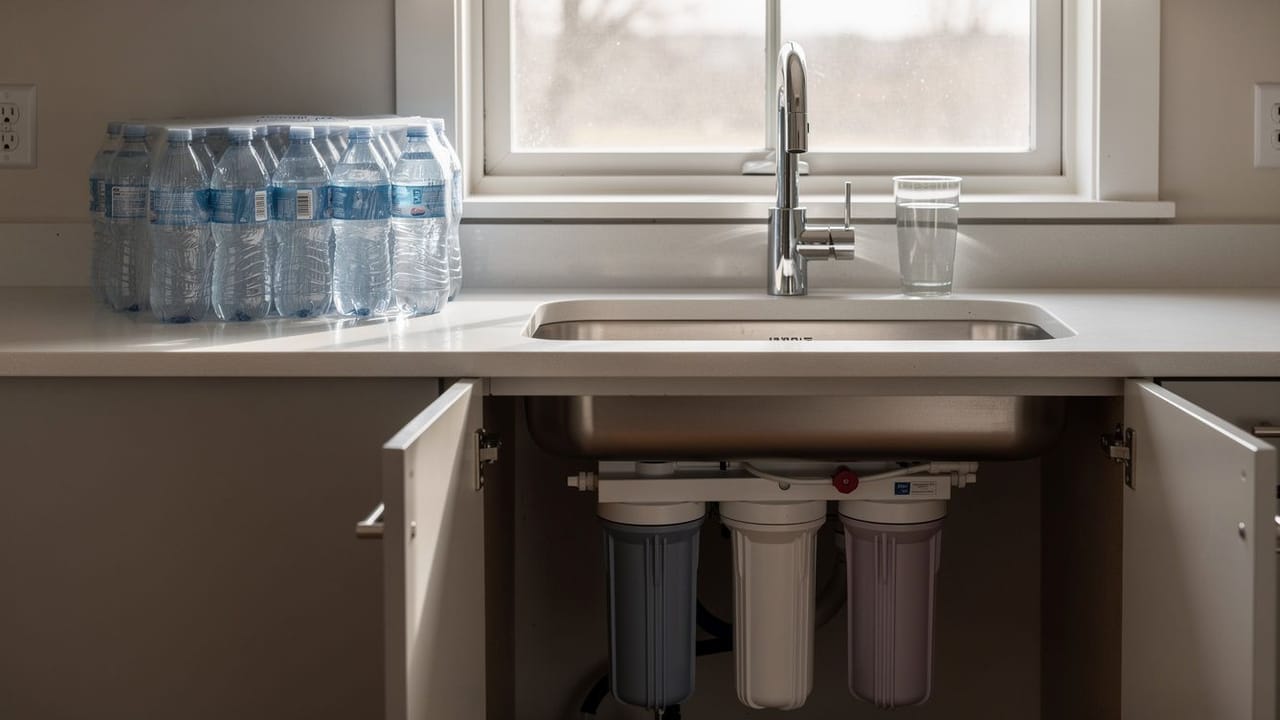
If the goal is water equal to the purified bottles, a reverse osmosis unit under the sink makes it from the cold line, with a dedicated faucet and a small tank. Our post on what reverse osmosis does and does not do covers its trade-offs, including the water it sends to the drain. Any of these only works if its cartridges are changed on schedule. To find out which one your water calls for, ask us for a free estimate.
Sources
- U.S. Food and Drug Administration, Bottled Water Everywhere: Keeping it Safe — FDA regulates bottled water and keeps its standards compatible with the EPA’s; lead 5 ppb bottled vs 15 ppb tap; definitions of spring, artesian, mineral and purified water; some bottled water comes from municipal sources and is treated
- Code of Federal Regulations, 21 CFR 165.110 Bottled water — Water from a community water system must be labeled as such unless treated to meet the purified or sterile definitions; purified water made by distillation, deionization, reverse osmosis or comparable treatment
- Metro Water Services, 2025 Consumer Confidence Report — Lead 90th percentile 0.8 ppb, 0 of 85 sites over the 15 ppb action level; FDA limits must give the same protection; sources of lead in home plumbing; corrosion control since 1987; boiling does not remove lead; certified filters
FAQ
Bottled Water or a Filter at the Tap in Nashville — questions
Does bottled water have a lower lead limit than tap water?
Yes. The FDA allows 5 parts per billion of lead in bottled water, while the EPA’s action level for tap water is 15. The FDA explains the gap by noting that bottled water does not pass through lead pipes, while tap water can pick up lead from service lines and household plumbing.
Can bottled water come from a city water supply?
Yes. The FDA says some bottled water comes from municipal sources. Under 21 CFR 165.110, it must be labeled “from a community water system” or “from a municipal source” unless it has been treated to meet the definition of purified or sterile water and is labeled that way instead.
How is spring water different from purified water?
Spring water is defined by its source: the FDA says it is collected at the spring or through a borehole into the formation that feeds it. Purified water is defined by its treatment, such as distillation, deionization or reverse osmosis, and can start from any source, including a city system.
Is a reverse osmosis filter as good as buying purified water?
In terms of process, it is the same kind of water. Federal rules list reverse osmosis among the treatments that can make water qualify as purified. An under-sink unit has to be sized for the household and kept up, with its prefilters and membrane changed on schedule, to keep making water of that quality.
Should you boil Nashville tap water to get rid of lead?
No. Metro Water Services’ 2025 report says boiling does not remove lead from water. It advises using only cold water for drinking, cooking and baby formula, flushing the lines when water has sat for hours, and using a filter certified for lead reduction by an ANSI-accredited certifier.